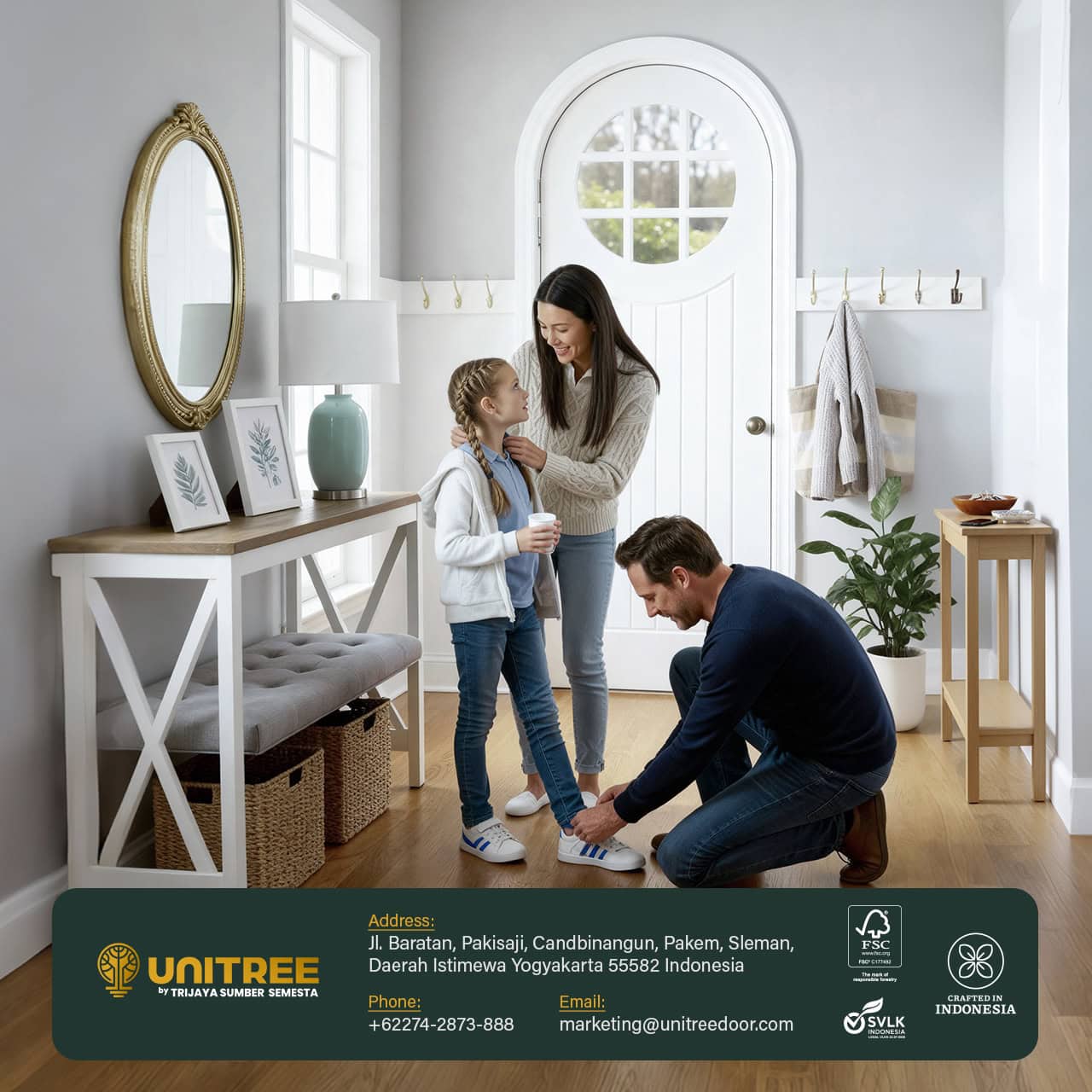
Biophilic architecture uses timber-framed canopies and expansive solid wood doors to create transitional spaces—often inspired by the Japanese engawa—that seamlessly connect interiors with the outdoors. Successfully executing these spaces requires specifying timber with high dimensional stability and proper moisture content (typically 8-12%) to withstand the contrasting humidity levels between conditioned interiors and external environments.
Why this matters: The desire to blur the boundary between sanctuary and nature is a hallmark of centuries-long architectural tradition. Recent projects, such as YNAS’s innovative residential designs, demonstrate how structural timber can be utilized not just as a support mechanism, but as a visual bridge that draws the eye outward. However, the true challenge for specifiers lies beneath the surface: ensuring that the natural materials used in these transitional zones possess the engineered resilience to endure without warping, maintaining both their silent operation and flawless finish.
What Role Do Timber-Framed Canopies Play in Transitional Architecture?
Timber-framed canopies act as a structural "third space" that mediates between the controlled interior environment and the unpredictable external climate. In Japanese architectural philosophy, this is represented by the engawa, a traditional porch that serves as a physical and visual transition. These structures control solar gain, filter natural light, and extend the interior flooring material outward to create the illusion of a single, continuous plane.
According to the Architectural Woodwork Institute (AWI), achieving this level of visual continuity requires premium-grade millwork that maintains tight tolerances despite exposure to varying temperatures. When specifying these structures, architects must consider:
- Visual Continuity: Using consistent species and grain patterns across the threshold to draw the eye toward the landscape.
- Spatial Proportion: Utilizing overhead timber rafters to define the "volume" of the outdoor space, making it feel like an extension of the room.
- Daylight Filtering: Using timber slats or louvers within the canopy to create rhythmic shadows, mimicking the "dappled light" effect found in forest environments.
How Do You Choose the Right Wood Species for Semi-Outdoor Exposure?
Selecting wood species for transitional zones requires a balance between aesthetic warmth and technical durability. Because these areas are subject to "semi-outdoor" conditions—meaning they are sheltered from direct rain but exposed to ambient humidity and wind—specifiers must prioritize species with high density or interlocked grain patterns.
For instance, Bangkirai (Yellow Balau) is frequently specified for structural framing due to its unwavering strength and natural resistance to decay. Conversely, for the interior-facing surfaces of a canopy or door, species like Sungkai or Mahogany provide a more refined, tactile warmth.
| Species | Character | Ideal Application | Performance Note |
|---|---|---|---|
| Bangkirai | Dense, interlocked grain | Heavy structural framing | Exceptional outdoor durability |
| Merbau | Deep reddish-brown | Thresholds and sills | High tannin content; very stable |
| Sungkai | Pale, contemporary grain | Ceiling panels, interior frames | Bright aesthetic; moderate density |
| Mahogany | Fine, uniform texture | Premium architectural doors | Classic luxury; resists shrinking |
| Albasia | Pale, lightweight, even | Core panels and louvers | Excellent workability; sustainable |
How Does Engineering Stability Prevent Warping in Transitional Zones?
Engineering stability in wood involves managing the internal stresses caused by moisture migration through cross-lamination and precision kiln-drying. In transitional zones, the "indoor" side of a timber element may face 40% humidity while the "outdoor" side faces 80%. This gradient causes standard solid wood to cup or twist.
To mitigate this, industry standards such as HPVA HP-1 recommend the use of engineered cores. PT. Trijaya Sumber Semesta (TSS) addresses this through the Nusantara Core, which utilizes a 1+3 recipe (1 finger-jointed strip plus 3 butt-jointed strips per layer). This configuration, combined with an orthogonal cross-laminated orientation, provides the necessary elasticity—achieving a Modulus of Rupture (MOR) of 25-30 MPa—to resist permanent deformation.
Technical requirements for specifying stable transitional timber include:
- Kiln-Dried Moisture Content: Ensuring a consistent 8-12% MC to prevent post-installation shrinkage.
- Orthogonal Layering: Specifying multi-ply cores where each layer counteracts the natural movement of the adjacent layer.
- Balanced Construction: Ensuring the face and back veneers are of similar density to maintain equilibrium.
How Can Architectural Doors Integrate with Timber Framing?
High-performance architectural doors should function as a continuation of the framing architecture rather than a disruption. In biophilic design, large-format doors often serve as the "operable wall" that completes the indoor-outdoor flow. The "Engineering Door" approach involves a hybrid construction: a stable, lightweight core for performance, wrapped in a solid S4S (Surfaced 4 Sides) hardwood lipping for superior edge durability.
This integration ensures that the door remains "silent" in its operation—no sticking, dragging, or creaking—even as the seasons change. By using FSC® C177492 certified materials, architects can ensure that the "Soul of the Space" is built on a foundation of both technical excellence and environmental responsibility. A well-specified door in a transitional zone acts as the quiet guardian of the sanctuary within, providing a reassuring, final click of the day regardless of the external elements.
FAQ
What is the Japanese concept of engawa in modern architecture?
The engawa is a traditional Japanese architectural element consisting of a covered corridor or veranda that runs along the perimeter of a house. In modern biophilic design, it is used as a blueprint for transitional spaces that use timber-framed canopies to blur the distinction between the interior living area and the exterior garden.
Which timber species are most dimensionally stable for indoor-outdoor framing?
Species with interlocked grains or high density, such as Bangkirai and Merbau, are highly stable for structural framing. For architectural millwork and doors, engineered cores like the Nusantara Core (using Albasia Falcata) provide superior stability by neutralizing the internal stresses of the wood through cross-lamination.
How do cross-laminated timber cores prevent doors from warping in semi-outdoor applications?
Cross-laminated cores consist of wood layers stacked in alternating directions. This orthogonal arrangement means that as one layer tries to expand with humidity, the adjacent layers (running perpendicularly) restrict that movement. This creates a panel that is significantly more stable than solid timber, which tends to move in a single direction.
What moisture content (MC) should architectural timber have for transitional residential spaces?
For most global markets, architectural timber should be kiln-dried to a moisture content of 8-12%. This range is the "sweet spot" for ensuring the wood is dry enough for conditioned interiors while remaining resilient enough to handle the higher humidity levels found in transitional, semi-outdoor zones.

